
How to save space
The mailbox we provide you with is large, but not bottomless. Once it fills up, the server stops accepting new mail – incoming messages are returned to their senders and you may lose them for good. Don't wait for that to happen. Keeping your mailbox at a reasonable size takes just a few minutes now and then.
What to do regularly
- Move older mail into local folders. The main advantage of messages stored on the server is that they are accessible from anywhere. You usually don't need that accessibility in the long term, though – over time messages become archival. Mail programs can also work with local folders stored on your computer's disk. Move older correspondence (especially bulkier messages with attachments) into local folders so that it doesn't needlessly take up space on the server.
- Delete mail you don't need. The vast majority of incoming correspondence contains no information of lasting value, and many messages are downright useless (unsolicited commercial offers and the like). Don't hesitate to delete them.
- Remove messages, don't just mark them as deleted. Many mail programs (depending on their configuration) don't actually remove deleted messages but only mark them as deleted, or move them to a folder that serves as a trash bin. Make sure you truly remove them (or set your mail client up appropriately so that it does so automatically).
How to check your current mailbox usage
The easiest way to find out how much space your correspondence takes up is to log in to the webmail. There, above the folder list on the left, you'll see your current disk space usage.
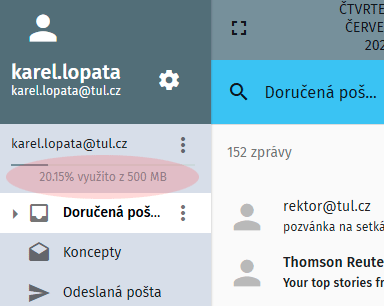
If you use Thunderbird, you can see your disk space usage in the bottom right of the status bar. The displayed usage is global. It covers your entire mailbox, not just the currently displayed folder.
Backing up local folders to external media
Once you move mail into local folders, it resides only on your computer's disk – there is no longer a copy of it on the server. We therefore recommend backing it up, whether against a disk failure or for a move to another computer. Follow the steps below.
1. Move mail from the server into local folders
The easiest way is to move an entire folder (or selected messages) via the context menu: right-click a folder or the selected messages in your email account and choose Move To → Local Folders. Note the difference from the Copy To option: copying leaves the original on the server, so the space in your mailbox wouldn't be freed until you delete the messages separately. To free up space, use Move To. Wait for the move to finish – with a large amount of mail it may take a while.
2. Find the local folders on your disk
Thunderbird stores local folders in its profile. You can find the path to it as follows:
- In Thunderbird, open Account Settings → Local Folders and read the value of Local Directory. That is the folder where your local mail physically resides.
- Alternatively, use Help → Troubleshooting Information and, next to Profile Folder, click the Open button. Typical profile locations:
- Windows:
C:\Users\<name>\AppData\Roaming\Thunderbird\Profiles\<profile>\Mail\Local Folders - macOS:
~/Library/Thunderbird/Profiles/<profile>/Mail/Local Folders - Linux:
~/.thunderbird/<profile>/Mail/Local Folders
For a backup it is enough to copy the entire Local Folders folder, which
ensures you don't miss anything.
Tip: Before copying, it's best to quit Thunderbird so that no files are open and the backup stays consistent.
3. Copy the folder to external media
Copy the entire Local Folders folder to an external disk or USB flash drive
in the usual way.
Back up to two different media rather than one. A single copy is not a backup – if that one medium fails, you lose everything. Ideally keep one external medium at the office and another elsewhere (for example at home).
4. Verify the backup
Open the copied folder on the external medium and check that the files have a non-zero size and match the original in size. If you want to be completely sure, try restoring the backup on another computer (see below) and verify that the messages appear.
5. Free up space on the server (and optionally on your disk)
If you used the Move To option in step 1, the messages were removed from the server by the move itself – the mailbox space was thus freed immediately. A move sometimes leaves a copy of the messages in the Trash folder, so empty it. If instead of moving you only copied the mail to the server, delete the original messages from the folders on the server now, and empty the trash as well. Only then is the space freed. Keep the local folders on your computer for as long as you need them; if you don't need them at the moment and you have a reliable backup, you may remove them from the computer as well.
Restoring the backup / moving to a new computer
On the new computer, install a mail client, find the path to its profile
(see step 2), and – with the program closed – copy the backed-up Local Folders
folder into it. Once you start the client, the local folders will appear along
with their messages.

Kdy jste naposledy četli Provozní řád počítačové sítě LIANE? Už ani nepamatujete? Tak to honem napravte.